

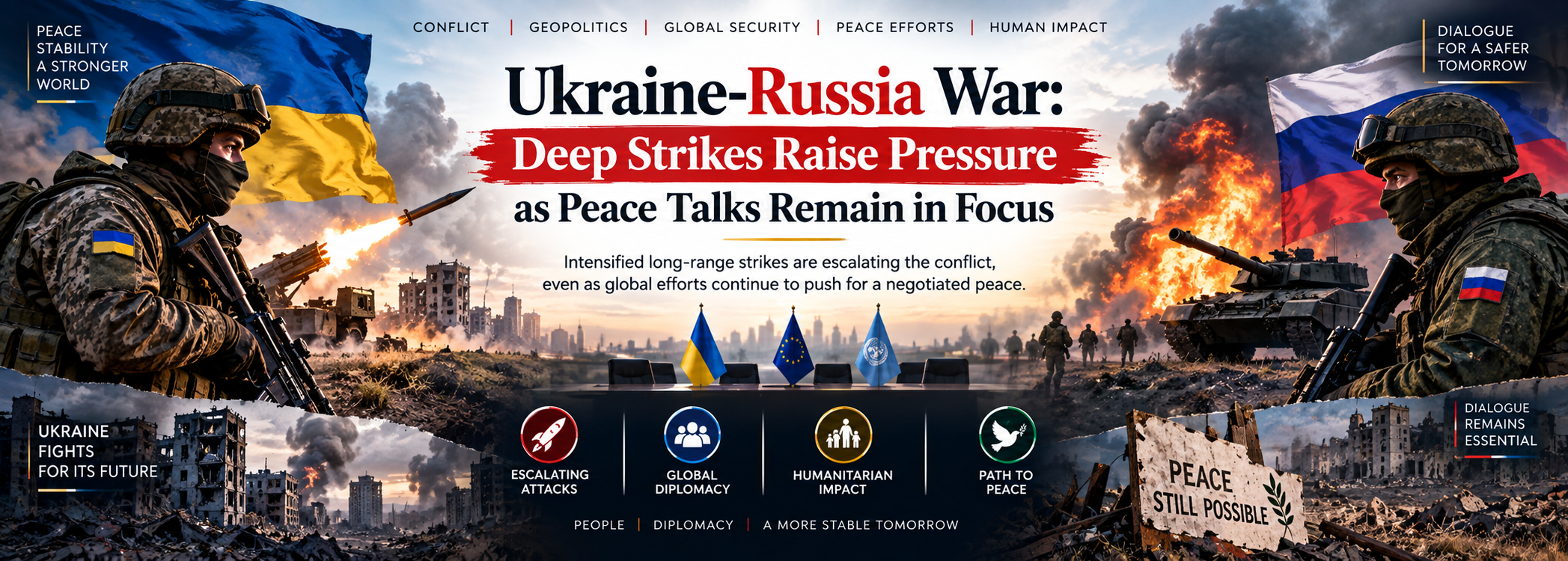
Ukraine-Russia War Enters Another High-Pressure Phase
The Ukraine-Russia war is entering another tense phase as military strikes increasingly reach deeper into Russian territory while diplomatic efforts to revive negotiations remain uncertain.
Ukraine has reported long-range strikes against energy-related facilities in Russia’s Yamal-Nenets region, one of the country’s most important natural-gas producing areas. The reported targets are located thousands of kilometres from the Ukrainian border, highlighting the growing reach of long-range weapons in the conflict.
At the same time, Moscow has signalled an interest in renewed negotiations, with Russian officials pointing to Abu Dhabi as a possible location for future talks.
The parallel developments underline the complicated nature of the conflict: military pressure continues even as diplomatic channels remain under discussion.
Ukraine Reports Deep Strikes Inside Russia
Ukrainian forces have claimed responsibility for attacks on facilities in the Yamal-Nenets region, an area widely regarded as central to Russia’s gas industry.
The reported targets include facilities around Novy Urengoy and the Purovsky district. Ukrainian officials described the strikes as attacks on important elements of Russia’s gas-condensate infrastructure.
The geographical distance is particularly significant.
The Yamal-Nenets region is far from the conventional front line, meaning that successful long-range attacks could force Russia to devote additional resources to protecting infrastructure well beyond the immediate battlefield.
For Ukraine, the ability to threaten strategically important infrastructure can provide another form of pressure against Russia.
Why Russia’s Gas Region Matters
Russia’s energy sector remains an important component of its economy and export system.
The Yamal-Nenets region is one of the country’s most significant natural-gas producing areas. Any sustained disruption to infrastructure in the region could therefore have implications beyond the immediate military conflict.
Energy infrastructure has become increasingly important in the wider Ukraine-Russia conflict because attacks against production, storage, transportation and processing facilities can affect both military logistics and economic resilience.
However, the longer-term impact of any individual strike depends on the extent of physical damage, the ability to restore operations and the broader condition of Russia’s energy infrastructure.
Moscow Signals Interest in Peace Talks
While military activity continues, Moscow has also indicated that it remains open to renewed diplomatic discussions.
Russian officials have pointed to Abu Dhabi in the United Arab Emirates as a potential location for future peace talks. The Kremlin has also said there is political will for negotiations, while maintaining demands concerning Western military support for Ukraine.
There have been no substantive Russia-Ukraine negotiations since February, according to current reporting.
The possibility of restarting talks therefore remains significant, but substantial political and security disagreements continue to stand between the two sides.
Ukraine Seeks Continued International Support
Ukrainian President Volodymyr Zelenskyy has continued diplomatic efforts to secure international backing for Ukraine.
During his visit to Canada, Zelenskyy focused on support for Ukraine’s air-defence capabilities and preparations for the coming winter, as Russian missile and drone attacks continue to threaten infrastructure.
Air defence has become particularly important as both sides increasingly rely on drones and long-range missiles.
For Ukraine, protecting electricity infrastructure, cities and critical facilities before winter remains a major strategic concern.
The Conflict Is Expanding Beyond the Traditional Front
One of the most important developments in the latest phase of the war is the increasing importance of long-range attacks.
The conflict is no longer defined solely by territorial battles along the front.
Energy facilities, military infrastructure, ports and other strategic targets increasingly form part of the wider battlefield.
Ukraine’s reported strikes deep inside Russia demonstrate the potential reach of modern long-range weapons, while Russian attacks against Ukrainian cities and infrastructure continue to create significant humanitarian and economic pressure.
Implications for Global Energy Markets
The conflict also continues to influence global energy security.
Russia remains one of the world’s major energy producers, while the wider geopolitical environment around the Black Sea, Europe and the Middle East has created additional uncertainty for global energy markets.
Any significant disruption to major production or transportation infrastructure can influence expectations around supply, prices and trade flows.
For countries dependent on imported energy, prolonged geopolitical instability can therefore create additional economic risks.
Europe Watches the Security Situation Closely
European governments continue to closely monitor the development of the war.
The conflict has already transformed European defence planning, military spending and energy policy.
The possibility of long-range strikes against infrastructure far from the front also creates new questions about how countries protect critical energy, transport and communications systems.
At the same time, European governments face the challenge of supporting Ukraine while managing their own economic and security priorities.
Peace Talks Remain the Key Question
The central question remains whether military pressure can eventually create conditions for meaningful negotiations.
The current situation presents two apparently contradictory developments:
Military escalation continues.
Diplomatic discussions remain possible.
That combination has defined much of the conflict in recent years.
Whether potential negotiations can progress will depend on the positions of Kyiv, Moscow, Washington and European governments, as well as developments on the battlefield.
For now, the conflict remains unresolved.
What Happens Next?
The coming weeks could be important for three reasons.
1. Military pressure
Ukraine’s ability to conduct long-range strikes could continue to place pressure on Russian strategic infrastructure.
2. Winter preparations
Both sides are preparing for another winter in which energy infrastructure and air-defence systems could become critical.
3. Diplomatic engagement
Any formal agreement to restart Russia-Ukraine negotiations would represent a significant diplomatic development, particularly if the United States and European countries become directly involved.
Why This Matters for the World
The Ukraine-Russia war is no longer only a regional European conflict.
It affects:
- Global energy markets
- European security
- Defence spending
- International diplomacy
- Food and commodity supply chains
- Air and missile defence technology
- Global geopolitical alliances
The latest developments show that the conflict continues to evolve even while diplomatic channels remain open.
For the international community, the challenge is to prevent further escalation while creating credible conditions for a durable political settlement.
FAQ
1. What is the latest development in the Ukraine-Russia war?
Ukraine has reported deep strikes against Russian energy-related infrastructure in the Yamal-Nenets region, while Russia has indicated interest in renewed peace discussions.
2. Where could Russia-Ukraine peace talks take place?
Russian officials have pointed to Abu Dhabi, United Arab Emirates, as a possible location for future discussions.
3. Why is Yamal-Nenets important?
Yamal-Nenets is a major Russian natural-gas producing region and contains strategically important energy infrastructure.
4. What is Ukraine seeking from international partners?
Ukraine is seeking continued military assistance, particularly air-defence support and help protecting critical infrastructure ahead of winter.
5. Is a peace agreement close?
Current reporting does not establish that a final peace agreement is close. Discussions remain possible, but major disagreements between the parties continue.