

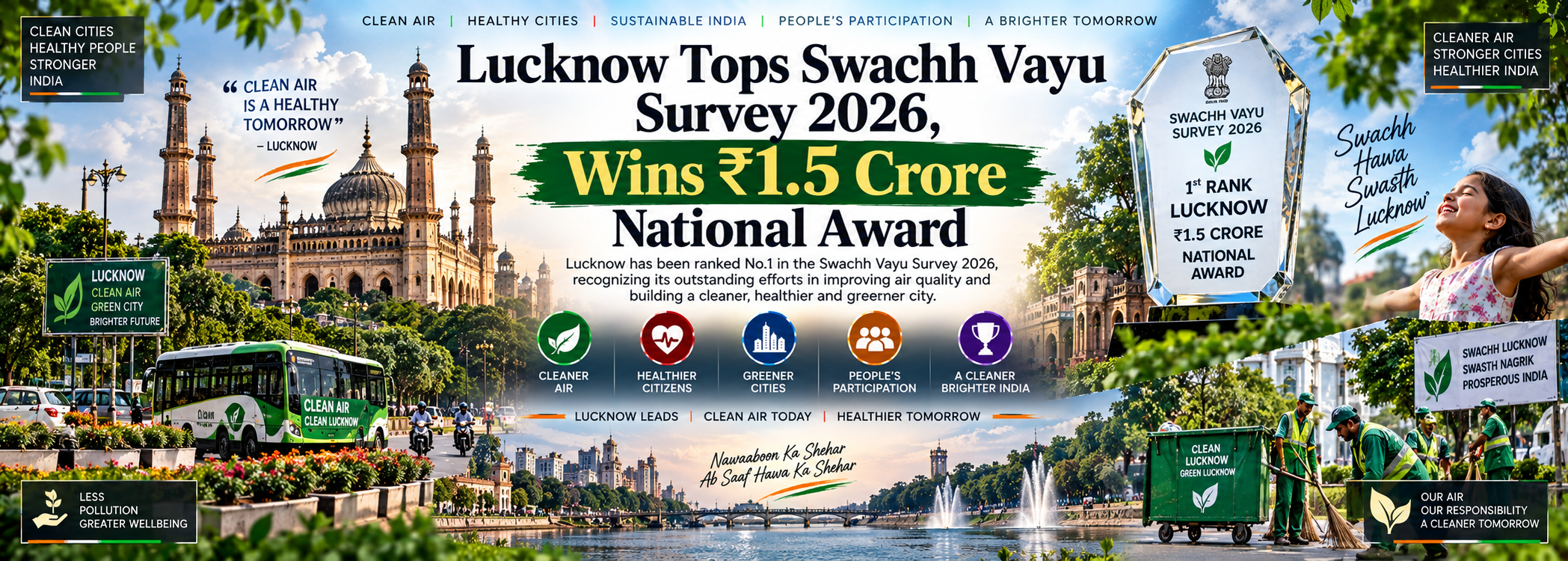
Lucknow Achieves No. 1 Rank in National Clean-Air Survey
Lucknow: Uttar Pradesh’s capital has achieved a major environmental milestone after securing the first position in Category 1 of Swachh Vayu Sarvekshan 2026, the Centre’s national assessment of cities’ efforts to improve air quality.
Lucknow scored 198 points, narrowly moving ahead of Madhya Pradesh’s Indore, which scored 197, while Jabalpur finished third with 195 points. The category covers cities with populations above 10 lakh.
The achievement marks a significant improvement for Lucknow, which had ranked much lower in the previous edition.
Sushma Kharkwal Receives National Award in Delhi
The national recognition was presented during a Clean Air Day event in New Delhi.
Lucknow Mayor Sushma Kharkwal, Municipal Commissioner Gaurav Kumar and other Lucknow Municipal Corporation officials received the award on behalf of the city.
The award carried a cash prize of ₹1.50 crore for Lucknow.
So, bhai, yahan exact fact ye hai:
Sushma Kharkwal ne Lucknow ki taraf se ₹1.50 crore ka award receive kiya — ye unka personal ₹1.50 crore award nahi hai.
Similarly, Indore’s second-place prize was ₹1 crore, which may be the source of the ₹1 crore figure you remembered.
Lucknow Beats Indore and Jabalpur
The result is particularly notable because Indore has traditionally been recognised for strong civic and cleanliness performance.
This time, however, Lucknow edged ahead in the clean-air assessment.
Category 1 rankings
| Rank | City | Score |
|---|---|---|
| 🥇 1 | Lucknow | 198 |
| 🥈 2 | Indore | 197 |
| 🥉 3 | Jabalpur | 195 |
The ranking is based on efforts and performance related to improving urban air quality rather than simply measuring one day’s AQI.
What Helped Lucknow Reach the Top?
Lucknow’s improvement has been linked to a combination of measures addressing several sources of urban pollution.
Among the measures highlighted in reporting and government material are:
- Road-dust control
- Mechanised road sweeping
- Improved waste management
- Measures against open waste burning
- Greater use of electric vehicles
- Expansion of green spaces
- Traffic-management initiatives
- Local-level clean-air efforts
These measures are important because urban air pollution does not come from a single source.
Traffic, road dust, construction activity, waste burning and industrial emissions can all contribute to particulate pollution.
Lucknow’s approach has therefore involved addressing several sources simultaneously.
Lucknow’s PM10 Levels Have Improved
The city’s achievement becomes more significant when viewed against its longer-term air-quality data.
According to reporting on the survey, Lucknow’s annual average PM10 concentration fell from around 253 micrograms per cubic metre in 2017–18 to about 135 micrograms per cubic metre in 2025–26, representing a substantial improvement.
However, there is an important qualification.
Being ranked No. 1 does not mean Lucknow’s air has already reached the national PM10 standard.
The city’s reported annual PM10 concentration remains above the national annual standard of 60 µg/m³.
That means the award recognises relative performance and improvement among cities in the survey, rather than declaring that Lucknow has completely solved its air-pollution problem.
Ward 70 Also Wins National Recognition
Lucknow’s success was not limited to the city-level award.
Ward 70 in Zone 4, identified as the Paper Mill area, ranked first nationally in the category for wards with populations above 30,000.
The ward received a ₹50 lakh cash award.
This is significant because it suggests that the city’s clean-air efforts are being assessed not only at the overall municipal level but also through local administrative units.
Why the Award Matters for Lucknow
For Lucknow, the recognition provides an opportunity to demonstrate that large and rapidly expanding cities can make measurable progress on air pollution.
The city faces many of the same pressures as other major urban centres:
Traffic → Construction → Road Dust → Waste → Urban Expansion
Managing these pressures becomes increasingly important as Lucknow’s population and built-up areas continue to expand.
The challenge now is to ensure that the improvement is sustained rather than becoming a one-year achievement.
The Bigger Environmental Challenge
Despite the No. 1 ranking, Lucknow still has considerable work ahead.
The city’s PM10 concentration remains above the national annual standard, meaning the next objective should be to move beyond ranking performance and achieve consistently healthier air for residents.
That will require continued attention to:
- Construction dust
- Road dust
- Traffic emissions
- Waste burning
- Industrial emissions
- Public transport
- Electric mobility
- Green cover
- Local pollution monitoring
A clean-air ranking is therefore best viewed as a milestone rather than an endpoint.
What Lucknow Can Learn From Its Own Success
One of the strongest lessons from Lucknow’s performance is that air-quality improvement requires coordinated action.
Simply improving one pollution source is unlikely to transform the overall situation.
The city’s progress suggests that a combination of:
Better municipal management + cleaner transport + dust control + waste management + green spaces
can produce measurable improvements.
The next challenge is maintaining that momentum.
Lucknow’s Environmental Moment
The recognition gives Lucknow an opportunity to strengthen its identity not only as Uttar Pradesh’s administrative capital but also as a city capable of improving its environmental management.
The award received in New Delhi provides national visibility to the city’s efforts.
But the real test will be what residents experience on Lucknow’s roads, in neighbourhoods and around major traffic and construction corridors over the coming years.
What Happens Next?
Lucknow’s next environmental target should be clear:
Move from being No. 1 in improvement performance to achieving sustained compliance with national air-quality standards.
That means maintaining the initiatives that helped the city rise from its previous ranking while strengthening measures where pollution remains high.
For residents, the ultimate measure of success will not be a trophy or ranking.
It will be cleaner air in everyday life.
Why This Matters for Uttar Pradesh
Lucknow’s result also carries significance for Uttar Pradesh.
If the state’s capital can demonstrate measurable improvement in air-quality management, other major UP cities can potentially learn from the same approaches.
Urban pollution is not restricted to one city, and the lessons from Lucknow’s experience could therefore be relevant to other growing urban centres across the state.
FAQ
1. What rank did Lucknow receive in Swachh Vayu Sarvekshan 2026?
Lucknow ranked No. 1 in Category 1, covering cities with populations above 10 lakh.
2. How many points did Lucknow score?
Lucknow scored 198 points, ahead of Indore with 197 and Jabalpur with 195.
3. How much prize money did Lucknow receive?
Lucknow received a ₹1.50 crore cash award for its first-place performance.
4. Did Sushma Kharkwal personally receive ₹1.50 crore?
No. Mayor Sushma Kharkwal received the award on behalf of Lucknow Municipal Corporation/city. The ₹1.50 crore is the prize awarded to Lucknow for its performance.
5. Which Lucknow ward won the national award?
Ward 70 in Zone 4 (Paper Mill area) ranked first in its category and received ₹50 lakh.
6. Has Lucknow completely solved its air-pollution problem?
No. The city has improved significantly, but its reported annual PM10 concentration remains above the national annual standard.