

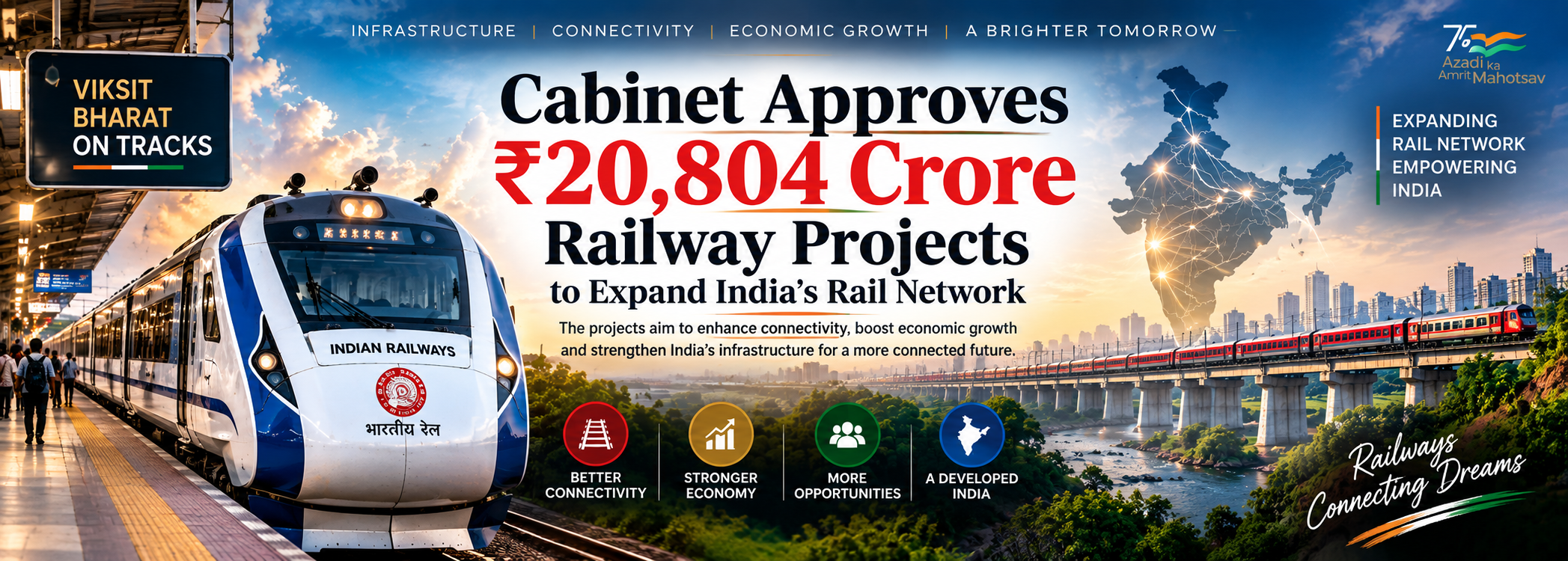
Cabinet Clears Major Railway Infrastructure Expansion
New Delhi: The Union government has approved a major railway infrastructure expansion plan involving eight multitracking projects with a combined estimated cost of ₹20,804 crore, strengthening rail connectivity and capacity across several parts of India.
The projects were approved by the Cabinet Committee on Economic Affairs and together are expected to add about 1,196 km to the existing railway network. The projects cover 31 districts across nine states and are targeted for completion by 2029–30.
The approval comes as India continues to invest in transport infrastructure designed to improve passenger mobility, freight movement and logistics efficiency.
Eight Projects Across Nine States
The approved projects cover major railway corridors across Tamil Nadu, Andhra Pradesh, Karnataka, Telangana, West Bengal, Jharkhand, Odisha, Madhya Pradesh and Chhattisgarh.
The southern group of projects includes additional lines and doubling works covering important routes such as Arakkonam–Renigunta, Whitefield–Bangarapet, Hosur–Omalur, Salem–Karur–Dindigul and Secunderabad–Kazipet.
Separately, three multitracking projects covering eastern and central India include the Kharagpur–Jharsuguda, Katni–Pendra Road and Bilaspur–Pendra Road corridors.
Focus on Congestion and Capacity
One of the central objectives of the projects is to increase railway line capacity on busy corridors.
Additional tracks can allow passenger and freight trains to operate with greater flexibility while reducing congestion on existing routes.
The government expects the projects to improve operational efficiency and service reliability, while also strengthening the movement of commodities and people across important economic corridors.
Freight Movement Gets a Major Push
The expansion is also significant from a logistics perspective.
According to government figures, the southern projects are expected to facilitate around 47 million tonnes per annum of additional freight traffic, while the three projects in eastern and central India are expected to add another 27 million tonnes per annum.
That puts the combined expected additional freight capacity at approximately 74 million tonnes per annum.
The railway corridors are important for transporting commodities including coal, cement, iron and steel, containers, automobiles, food grains, petroleum products and fertilisers.
Connectivity for Villages and Regional Economies
The projects are also expected to improve connectivity for thousands of villages located along the affected railway corridors.
The southern projects alone are expected to improve connectivity to approximately 2,121 villages, while the eastern and central projects cover additional districts and communities.
Better railway connectivity can support regional businesses by improving access to markets, reducing transportation bottlenecks and making the movement of goods more efficient.
For passenger services, additional capacity can also create opportunities for improved train operations and better connectivity to important cities, industrial centres and tourist destinations.
Projects Aligned With PM Gati Shakti
The railway expansion projects have been planned under the PM Gati Shakti National Master Plan, with an emphasis on multimodal connectivity and logistics efficiency.
The approach is intended to coordinate infrastructure development across different transportation networks rather than treating individual projects in isolation.
For India, this is particularly important as the country continues to expand manufacturing, logistics, industrial production and domestic transportation infrastructure.
Environmental and Logistics Benefits
The government has also highlighted potential environmental and fuel-saving benefits from the capacity expansion.
The five southern projects are estimated to reduce oil imports by around 80 million litres and CO₂ emissions by approximately 420 million kg.
The three eastern and central projects are estimated to reduce oil imports by about 120 million litres and CO₂ emissions by around 620 million kg, according to the respective government releases.
These estimates underline the government’s broader objective of moving more freight through an energy-efficient railway network.
What the Railway Expansion Means for India
The latest approvals are part of a broader effort to strengthen India’s transportation infrastructure.
For passengers, additional railway capacity can help improve connectivity and operational reliability. For businesses, stronger freight corridors can reduce logistics constraints and improve access to markets.
For industries dependent on bulk commodities, containers and raw materials, additional railway capacity could also provide greater transportation flexibility.
The longer-term impact will depend on timely execution, land availability, construction progress and the ability of the new infrastructure to integrate effectively with existing railway operations.
A Long-Term Infrastructure Investment
With completion targeted for 2029–30, the newly approved projects represent a long-term investment rather than an immediate capacity change.
The scale of the programme reflects the continuing importance of railways to India’s economic infrastructure, particularly as freight movement, industrial production and inter-city connectivity expand.
For India’s infrastructure story, the focus is increasingly shifting from simply building new routes to expanding capacity, reducing congestion and improving the efficiency of existing corridors.
Why This Matters
India’s railway network remains one of the country’s most important transportation systems.
The latest multitracking approvals matter because they address three connected priorities:
Connectivity → Capacity → Logistics Efficiency
More railway capacity can help move people and goods more efficiently, while improved freight corridors can support industrial and economic activity.
The success of the programme, however, will ultimately depend on execution and timely completion of the approved projects.
FAQ
1. How much has the Cabinet approved for the new railway projects?
The Cabinet has approved eight multitracking projects with a combined estimated cost of approximately ₹20,804 crore.
2. How much railway network will be added?
The projects are expected to add about 1,196 km to the existing railway network.
3. How many states are covered?
The projects cover nine states: Tamil Nadu, Andhra Pradesh, Karnataka, Telangana, West Bengal, Jharkhand, Odisha, Madhya Pradesh and Chhattisgarh.
4. When are the projects expected to be completed?
The projects are planned for completion by 2029–30.
5. What is the expected freight benefit?
The projects are expected to facilitate approximately 74 million tonnes per annum of additional freight traffic.
6. Are the projects part of PM Gati Shakti?
Yes. The projects have been planned under the PM Gati Shakti National Master Plan, with emphasis on multimodal connectivity and logistics efficiency.